

How Much Does a Retaining Wall Cost in Seattle?
One of the first questions homeowners ask is, “How much will my retaining wall cost?” The honest answer: it depends on the property.
Height and length matter, but they’re only part of the price. Access, excavation, haul-off, drainage, soil conditions, existing wall removal, material choice, engineering, permits, and nearby loads all affect the final cost. A wall holding back a slope, driveway, patio, fence, or another structure is a different project from a small landscape wall in an open yard.
That’s especially true around Seattle, Bellevue, and the Eastside, where many properties have steep slopes, wet soils, narrow side yards, older failing walls, and drainage problems that aren’t visible from the street.
Quick answer: In the Seattle area, most real residential retaining wall projects start around $5,000 once excavation, drainage, delivery, and cleanup are included. Small decorative or landscape walls typically run $5,000 to $12,000+. Moderate residential walls and rockeries commonly fall in the $12,000 to $35,000+ range. Larger, taller, multi-tier, engineered, replacement, or slope-stabilization projects can run $35,000 to $100,000+. Existing wall replacement and slope stabilization vary widely because demolition, temporary stabilization, drainage correction, and disposal can change the scope quickly.
These are planning ranges, not quotes. The only reliable way to price a wall is to evaluate the site: access, drainage, height, materials, removal, and local permit or engineering requirements.
Seattle Rockeries builds retaining walls, rockery walls, block walls, drainage, natural stone steps, grading, and hardscape across Seattle, Bellevue, and the Eastside. This guide breaks down the main cost drivers so you can budget realistically before requesting an estimate.
Typical Retaining Wall Cost Ranges in the Seattle Area
The table below is for early planning. Final pricing depends on site conditions, current material and disposal costs, labor, access, permits, engineering, and the full scope of work.
| Project Type | Typical Planning Range | Common Reasons Costs Move Higher |
|---|---|---|
| Small decorative or landscape wall | $5,000 – $12,000+ | Good access, limited retaining height, minimal excavation, limited haul-off, and no major drainage, demolition, or permit issues. |
| Moderate residential retaining wall or rockery | $12,000 – $35,000+ | More wall length or height, drainage work, excavation, material delivery, haul-off, old wall removal, and site restoration. |
| Larger, taller, or multi-tier retaining wall system | $35,000 – $100,000+ | Engineering, permits, difficult access, steep slopes, ECA or critical-area considerations, surcharge loads, substantial excavation, and larger material volumes. |
| Existing wall replacement or slope stabilization | Varies widely | Old wall removal, temporary stabilization, disposal, drainage correction, access limitations, utilities, nearby structures, and design requirements. |
A low advertised price is misleading if it leaves out drainage, excavation, disposal, base prep, difficult access, or required design work. For most Seattle-area properties, the real question isn’t the wall size. It’s what has to happen behind, under, and around the wall for it to hold up over time.
Planning Examples: Why Similar-Looking Walls Price Differently
A few planning examples, not quotes. Access, drainage, removal, soil, and engineering can move any of these up or down.
- A 3-foot, 30-foot wall with good machine access (about 90 square face feet): roughly $5,000 to $12,000 for block, higher when natural stone, difficult access, added drainage, or engineered design is involved. This is the typical small backyard or landscape wall.
- A 4-foot, 50-foot wall (about 200 square feet) with some drainage and access work: roughly $8,000 to $24,000.
- A 6-foot or taller hillside wall, or a failing timber wall replacement with demolition, haul-off, drainage correction, difficult access, and possible engineering: $35,000 and up, with complex multi-tier systems or slope-stabilization work sometimes reaching six figures.
Height is the swing factor, and it doesn’t scale in a straight line. A 6-foot wall can run three to four times a 3-foot wall once you add the deeper footing, reinforcement, engineering, and drainage that the extra height demands.
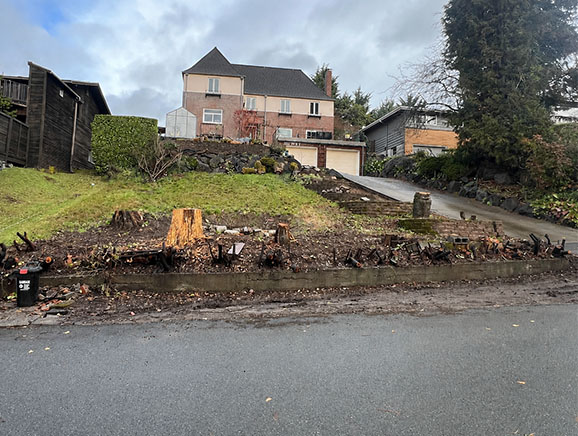
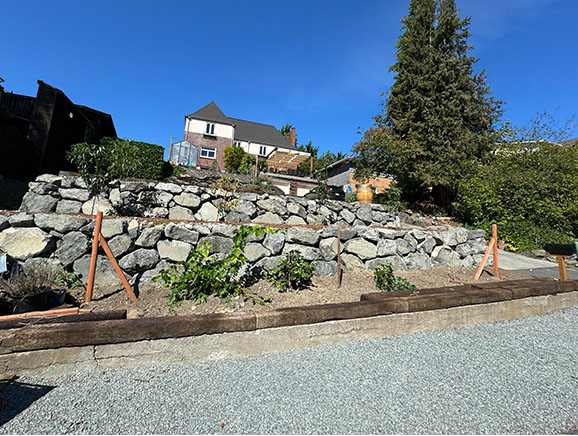
Real Project Example: Multi-Tier Rockery Wall Installation
The project below illustrates how site conditions, excavation, drainage, access, and wall design can significantly influence the scope and cost of a retaining wall project. While every property is different, transformations like this are common throughout Seattle, Bellevue, Issaquah, Sammamish, and other Eastside communities.
Why Square-Foot Pricing Can Be Misleading
Homeowners often look for a simple cost per square foot. It’s useful for rough comparison, but misleading in Seattle.
Two walls with the same face area can cost very differently. One is a short wall in an open front yard with good equipment access. The other sits behind the house, down steps, against a steep slope and near a fence, with an old timber wall to remove and drainage to correct. The second costs far more even though it looks similar in a photo. That’s why a real estimate looks at the whole site, not just the wall face.
Why Retaining Walls Cost More on Seattle and Eastside Lots
Around here, the wall is the easy part. What drives the price is everything the lot throws at it. Many local properties sit on slopes, hold water in clay-heavy or glacial soils through a long wet season, and leave just enough room to make access a fight. Add an old timber wall that has to come out, and the real work starts before the first new rock is set.
None of that means a sloped lot is doomed. It means drainage, access, and how the soil behaves carry more weight here than on a flat, open lot, and some walls need an engineer’s eyes before they go in.
A 3-foot wall with machine access in Bellevue is a different job from a 7-foot failing wall behind a Seattle home you can only reach down a side yard. A Mercer Island wall near a driveway or waterfront slope raises access and design questions a small garden wall never will. An Issaquah or Sammamish slope with a drainage problem can need water management and excavation before the new wall even starts.
So the real cost isn’t the wall. It’s how the equipment gets in, how much soil moves, where the water goes, and whether the design needs engineering or city review.
Seattle Retaining Wall Cost Drivers at a Glance
| Cost Factor | Impact on Price | Why It Matters |
|---|---|---|
| Wall height | High | Taller walls need more excavation, base prep, drainage, reinforcement, and sometimes engineering. |
| Wall length | High | Longer walls need more material, labor, drainage, backfill, and disposal. |
| Site access | Very high | Tight access means smaller equipment, hand work, longer staging, and more labor. |
| Drainage | Very high | Seattle-area walls need proper water management to relieve pressure behind the wall. |
| Existing wall removal | High | Demolition, sorting, haul-off, and temporary stabilization add major scope. |
| Soil and slope conditions | High | Wet soils, steep slopes, and unstable ground increase planning and construction needs. |
| Permits and engineering | Moderate to high | Taller walls, surcharge loads, critical areas, and complex sites trigger additional review. |
| Site restoration | Moderate | Landscaping, patios, stairs, fences, irrigation, and cleanup affect the full project cost. |
The Biggest Retaining Wall Cost Drivers
1. Wall Height and Soil Loads
Height is one of the largest cost factors. A low garden wall is a different animal from a taller wall holding back significant soil or supporting a driveway, patio, slope, fence, deck, or another wall above it. As height and retained soil go up, the project needs more excavation, a larger base, stronger materials, reinforcement, possible engineering, and more detailed drainage.
2. Wall Length and Layout
Longer walls mean more material, labor, excavation, drainage, and disposal. Layout matters too. Curves, corners, tiers, stairs, transitions around patios, and walls near driveways or property lines take more planning and labor than a straight run with easy access.
3. Material Selection: Rockery, Block, Boulder, or Replacement Wall
Different materials carry different looks, install requirements, and costs. The right one depends on slope, access, height, soil, drainage, budget, the look you want, and whether the design is prescriptive or engineered. For a more detailed comparison of these options, see our guide to the different types of retaining walls and blocks
Natural Rockeries
Natural rock walls fit the Pacific Northwest landscape, drain well when built right, and last. Cost depends on rock size, wall height, equipment access, delivery, placement, excavation, and whether the design is prescriptive or engineered.
Concrete Block Retaining Walls
Segmental concrete block gives a clean, consistent look. It’s often the right call for tighter geometry, a uniform appearance, or where an engineered system fits. Cost depends on the block system, base prep, geogrid or reinforcement, drainage, geometry, and access.
Boulders and Landscape Stone
Large boulders and landscape stone create a natural look while stabilizing slopes or defining outdoor space. Price depends on stone size, equipment access, site conditions, delivery, excavation, placement, and how the stone ties into the yard.
Timber or Failing Wall Replacement
Replacing old timber, failing block, or shifting rock usually costs more than building on a clean site. Removal, sorting, disposal, temporary stabilization, and drainage correction all add time and cost.
4. Site Accessibility
Access can change a wall’s cost dramatically. A backyard with room for equipment, delivery, and staging is a different job from a tight side yard where everything moves by hand or with small machines.
- Can excavation equipment reach the work area?
- Is there room to deliver and stage rock, block, drain rock, pipe, fabric, and tools?
- Will fences, stairs, utilities, trees, patios, lawns, or landscaping limit access?
- Can spoils be hauled out efficiently, or does it take hand work?
- Is the wall near a property line, driveway, house, deck, fence, or neighboring structure?
Tight access means more labor hours, smaller equipment, more protection of existing surfaces, and more planning around staging and haul-off.
5. Drainage and Water Management
Drainage is not an optional upgrade. It is one of the most important parts of a retaining wall system in the Pacific Northwest.
A well-built retaining wall includes:
- Drain rock behind the wall
- Perforated drain pipe where appropriate
- Filter or geotextile fabric to separate soil from drainage material
- Surface water management that directs roof, patio, driveway, and slope runoff
- A safe discharge or connection point when the site and local rules require it
Skipping drainage to save money builds pressure behind the wall and leads to movement, settlement, erosion, and expensive repairs. In Seattle-area conditions, proper drainage costs far less than rebuilding a failed wall.
For a closer look at how these components work together, see our guide to proper drainage behind a retaining wall in the Pacific Northwest.
6. Demolition, Excavation, and Hauling
Replacing a failing wall usually costs more than building on a clean site. Old rock, concrete, block, timber, soil, roots, and debris often have to come out first, sometimes with temporary stabilization, careful demo near structures, and disposal fees. Excavation and haul-off can be a major line item, especially when access is tight or the wall sits down a slope or behind the house.
7. Engineering, Permits, ECA, and Steep-Slope Conditions
Permitting and engineering requirements depend on the wall, the property, and the jurisdiction. Seattle, Bellevue, Mercer Island, Kirkland, Redmond, Sammamish, Issaquah, unincorporated King County, and other cities may have different requirements.
In Seattle, the Department of Construction & Inspections generally looks at factors such as wall height, environmentally critical areas, potential impacts to adjoining properties, grading, and whether drainage connects to regulated systems. Bellevue and King County have their own rules and thresholds.
Seattle Rockeries can help homeowners identify common issues that may trigger engineering, permitting, or further review, and can coordinate with engineers or permit professionals when appropriate. Final permit determinations should come from the relevant jurisdiction or qualified design professional.
8. Site Restoration and Related Outdoor Work
Retaining wall work usually touches nearby landscaping, patios, fences, lawns, stairs, irrigation, lighting, drainage, and planting areas. A quote that includes cleanup, restoration, or related hardscape will look higher than a bare-wall quote, but it reflects the real scope of the project.
Rockery Wall Cost vs. Block Retaining Wall Cost
Homeowners often ask whether a rockery wall or block retaining wall is cheaper. There’s no single answer, because the right comparison depends on the property.
| Option | Often Best For | Cost Factors |
|---|---|---|
| Natural rockery wall | Sloped yards, natural Pacific Northwest appearance, terraced planting areas, hillside landscapes. | Rock size, delivery, equipment access, wall height, placement time, drainage, excavation, and design requirements. |
| Segmental concrete block wall | Clean lines, structured patios, taller or more precise walls, projects where an engineered wall system may be appropriate. | Block system, base prep, geogrid or reinforcement, wall geometry, drainage, corners, caps, and access. |
| Large boulder or landscape stone wall | Natural slope transitions, informal terraces, landscape definition, and certain erosion-control applications. | Boulder size, equipment access, staging, excavation, placement, and integration with the yard. |
A natural rockery is often the better visual fit for a wooded or hillside property. Block is often better for a patio, driveway, or any design that needs tighter lines. The cheapest option isn’t the best long-term option if it compromises drainage, access, or how the wall performs.
What a Strong Retaining Wall Estimate Should Include
A good estimate makes the scope clear. You should know what’s included, what’s excluded, and what could change the price.
- Wall location, approximate height, length, layout, and material
- Demolition or removal of existing walls, if any
- Excavation, base prep, and backfill approach
- Drainage strategy: drain rock, pipe, fabric, and surface water
- Material delivery, staging, equipment access, and haul-off
- Restoration of disturbed areas, if included
- Permit, engineering, or design assumptions
- Known exclusions, unknowns, or conditions that need further review
The cheapest quote isn’t always the best. If a proposal leaves out drainage, disposal, access challenges, permitting, or restoration, it isn’t showing the true project cost.
When a Retaining Wall Quote Usually Gets More Expensive
Costs climb when the project includes one or more of these:
- The wall is taller, longer, curved, tiered, or built near another wall
- It supports a driveway, patio, slope, fence, structure, or surcharge load
- Access is tight and material moves by hand or with small equipment
- An old timber, concrete, block, or rock wall has to come out first
- Drainage problems have to be corrected before or during construction
- The work is near a property line, utility, tree, house, deck, or neighbor’s structure
- The site involves steep slopes, critical areas, grading limits, or permit review
- You want integrated steps, patios, paths, terraces, fencing, lighting, or new landscaping
Seattle, Bellevue, and Unincorporated King County Permit Considerations
Permit requirements depend on the jurisdiction, wall height, site conditions, slope, surcharge loads, critical areas, grading, drainage, and proximity to neighboring properties or structures. The notes below are for planning only. Homeowners should verify current requirements with the city, county, or a qualified design professional before construction.
| Jurisdiction | Planning Notes to Verify Before Building |
|---|---|
| Seattle / SDCI | A construction permit may not be needed only when all listed conditions are met: the retaining wall or rockery is 4 feet or lower measured from the bottom of the footing to the top of the wall, the wall is not located on a parcel with an environmentally critical area, and the work will not damage adjoining properties or structures. If those conditions are not met, a construction permit may be required. A grading permit may also apply depending on soil movement or disturbed area. Rockery designs must meet prescriptive standards or be prepared by a geotechnical engineer, and connecting wall drainage to a side sewer may require a separate permit. Property-line proximity and right-of-way work can also affect the project. |
| Bellevue | A permit is generally required for retaining walls over 4 feet high measured from the bottom of the footing to the top of the wall, or for any retaining wall supporting a surcharge load. Sites in the Critical Areas Overlay District, setback areas, rockery drainage connections, clearing, grading, and stormwater work can also affect permit requirements. |
| Unincorporated King County | King County code generally exempts retaining walls not over 4 feet high measured from the bottom of the footing to the top of the wall, unless the wall supports a surcharge or impounds certain liquids. Site conditions, drainage, grading, critical areas, steep slopes, shoreline, flood, right-of-way work, utilities, septic, and other approvals can still affect the project. Properties inside incorporated cities within King County, such as Seattle, Bellevue, Kirkland, Redmond, Renton, Issaquah, Shoreline, Mercer Island, Sammamish, and Snoqualmie, may be governed by that city’s permit rules instead. |
Seattle Rockeries can help flag common permitting questions, but final determinations should come from SDCI, Bellevue, King County, the applicable city, or a qualified design professional.
Official permit resources:
- Seattle SDCI – Retaining Walls & Rockeries: https://www.seattle.gov/sdci/permits/common-projects/retaining-walls-and-rockeries
- City of Bellevue – Work Requiring Permits: https://bellevuewa.gov/city-government/departments/development/permits/faqs/work-requiring-permits
- King County – Do You Need a Permit?: https://kingcounty.gov/en/dept/local-services/certificates-permits-licenses/permits/permits-inspections-codes-buildings-land-use/do-you-need-a-permit
- King County Code, Title 16 (building code): https://aqua.kingcounty.gov/council/clerk/code/19_Title_16.pdf
How to Get a More Accurate Retaining Wall Estimate
You don’t need to design the wall in advance. Gathering a few details up front makes the first conversation far more productive:
- Approximate wall height and length
- Photos of the wall area from several angles
- Photos or video of access from the street, driveway, side yard, and backyard
- Whether an existing wall needs to come out
- Any drainage problems, standing water, erosion, or slope movement
- Nearby structures, driveways, fences, stairs, patios, utilities, trees, or property lines
- Any past permits, surveys, engineering drawings, or property records that apply
The more you share, the easier it is to flag likely cost drivers, permit questions, and practical options.
Seattle Retaining Wall Cost FAQ
How much does a retaining wall cost in Seattle?
Most Seattle-area projects land between several thousand dollars and well into the five figures. Small decorative walls with easy access sit at the low end. Taller, multi-tier, engineered, or difficult-access walls run much higher. An on-site evaluation is the only reliable way to price the work.
How much does a rockery wall cost compared with a concrete block wall?
There’s no single answer, because it depends on access, height, rock size, drainage, engineering needs, geometry, and the look you want. Natural rockeries are a strong fit for many Pacific Northwest landscapes. Block is often preferred when you want a consistent engineered system or a specific finished look.
Can retaining wall cost be estimated by square foot?
Square-foot pricing is misleading. Two walls with the same face area can cost very differently if one has tight access, poor drainage, an old wall to remove, steep-slope conditions, or engineering requirements. A real estimate looks at the whole site, not just the visible wall face.
Why does access affect retaining wall pricing so much?
Retaining walls need heavy material, excavation, drain rock, pipe, fabric, tools, and often soil removal. When a machine can reach the work area, the job moves efficiently. When material travels by hand through a narrow side yard or down steps, labor and staging time climb fast.
Why is drainage such a big part of the cost?
Water is the main cause of retaining wall failure. Good drainage relieves pressure behind the wall and manages runoff. In rainy Seattle conditions, it’s core to whether the wall performs, not an afterthought.
Do I need a permit for a retaining wall in Seattle?
Possibly. In Seattle, retaining wall and rockery permit requirements can depend on height, environmentally critical area status, adjoining property impacts, grading, drainage, and other site conditions. Always verify with SDCI or the local jurisdiction before building.
Do Bellevue and unincorporated King County have the same retaining wall permit rules as Seattle?
Not exactly. Bellevue, King County, and nearby cities may use similar height thresholds, but local rules, critical areas, setbacks, surcharge loads, grading, and drainage connections can change the requirements. Verify with the jurisdiction where the property is located.
Can I save money by reusing existing rock or block?
Sometimes, not always. It depends on the condition, size, shape, and structural suitability of the material, and whether it can be removed and reset efficiently. In some cases, salvaging costs more than buying new because of the extra handling and sorting.
Does replacing a failing wall cost more than building a new wall?
Often, yes. Replacement can mean demolition, sorting, haul-off, temporary stabilization, drainage correction, and careful work around established landscaping, structures, utilities, or property lines.
Is a retaining wall worth the investment?
For many Seattle-area properties, yes. A wall built and drained correctly stabilizes slopes, slows erosion, improves drainage, creates usable outdoor space, improves access, and protects long-term property value.
When does a retaining wall need engineering?
A retaining wall may need engineering when it’s taller, supports a surcharge load, sits near a driveway, patio, structure, slope, property line, or critical area, or when local rules require design review. The need depends on the wall, site, soil, drainage, and jurisdiction.
What is a surcharge load?
A surcharge is extra weight or pressure above or behind the wall, such as a driveway, parked vehicle, patio, building, fence, slope, or another wall. Surcharge loads can change the wall’s design, permitting, and cost.
Does a 4-foot retaining wall always avoid a permit?
No. The 4-foot threshold is only one factor. Critical areas, surcharge loads, grading, drainage connections, property-line impacts, adjoining structures, right-of-way work, and local city rules can all still trigger review or a permit.
Why do old timber retaining walls cost more to replace?
The cost isn’t just the new wall, it’s the removal and rebuild. Old timber walls usually mean demolition, disposal, unstable soil, drainage correction, and careful work around landscaping, utilities, fences, patios, or structures.
Can drainage behind a retaining wall connect to the city storm system?
Sometimes, but the connection can require review or a permit depending on the jurisdiction and the existing system. Verify storm, side sewer, or drainage-connection requirements before construction.
What should I send Seattle Rockeries before requesting a quote?
Photos or video of the wall area, approximate height and length, access from the street or driveway, the condition of any existing wall, drainage or erosion issues, and any nearby fences, patios, stairs, utilities, trees, driveways, or property lines.
Why Homeowners Choose Seattle Rockeries
Seattle Rockeries builds retaining walls, rockeries, block walls, drainage, and hardscape across the Seattle region. We’ve spent more than two decades on the thing that actually makes local walls fail: water on slopes with tight access. We look at the site first, recommend the material that fits it, and walk you through the tradeoffs before anyone starts digging.
Small landscape wall or full hillside replacement, you’ll get a straight read on the options, the budget, and the permitting questions for your property. Explore our rockery wall, block retaining wall, and drainage and water management services, or browse recent project photos.
Request a Retaining Wall Consultation
Every property is different. An on-site evaluation is the best way to understand access, drainage, materials, wall design, permitting, and realistic cost.
For a faster first review, call or text Seattle Rockeries at (206) 960-9003 and send photos or video of:
- The wall area or slope
- Access from the street, driveway, side yard, or backyard
- Any existing wall that needs removal
- Drainage, erosion, or standing water
- Nearby fences, patios, driveways, stairs, utilities, trees, or property lines
Prefer to start online? Use our Get-A-Quote form with the same details and we’ll follow up.
Seattle Rockeries serves homeowners across King County, including Seattle, Bellevue, Mercer Island, Kirkland, Redmond, Renton, Issaquah, Sammamish, Snoqualmie, Newcastle, and surrounding communities.
Contact us today to schedule a retaining wall consultation and get a customized estimate for your property.